
The narrative around automation in Australian manufacturing has a standard shape. Robots replace repetitive tasks. Headcount drops. Labour costs fall. Productivity improves. The labour hire industry shrinks.
It is a tidy story. It is also missing the most important part of what is actually happening on the floor of Australian manufacturing facilities right now.
The Ai Group's State of Industry Report consistently shows that Australian manufacturers are investing in automation — conveyors, robotic assembly cells, automated picking systems, CNC upgrades, and warehouse management technologies — at a meaningful rate. But the same report tracks the skills that businesses say they cannot fill. The lists do not get shorter as automation investment increases. They change shape. And the roles at the top of the hard-to-fill list are increasingly the ones that sit next to the automation, not the ones it replaced.
What automation is actually replacing in Australian manufacturing
ABS Manufacturing Activity data shows that the roles most susceptible to automation in the Australian context are those with high task repetition and low variability: manual assembly, basic pick-and-pack, repetitive machine tending, and straightforward line inspection. These are roles that many manufacturers have already automated, are in the process of automating, or have on a capital expenditure plan for the next three years.
McKinsey's global research on manufacturing automation puts the proportion of tasks — not jobs, but tasks — that are automatable in manufacturing at around 50 to 60 percent. In the Australian manufacturing context, that proportion is lower due to the scale and structure of most operations here. The average Australian manufacturer is not a tier-one automotive supplier with a greenfield facility designed around robotics from the ground up. It is a mid-sized operation with a mix of equipment ages, production volumes that vary seasonally, and a need for flexibility that full automation does not readily provide.
What this means in practice: Australian manufacturers automate the tasks where the volume and consistency justify the capital outlay, and they continue to need skilled people for everything else. The ratio of automated to manual tasks shifts — but the need for qualified, reliable people does not go away. It concentrates.
Why the remaining roles are harder to fill
When a manufacturer automates a repetitive manual task, the person who was doing that task does not become redundant in most real-world scenarios. The work around that task changes. The person monitoring the automated cell needs to understand what the cell is doing, identify when something is wrong, and respond to exceptions that the automation cannot handle. The person operating the forklift next to an automated picking system is now working in a more complex, more safety-critical environment than before. The quality inspector reviewing output from an automated line needs to understand what the automated process should be producing, not just whether a product looks right on visual inspection.
Deloitte's research on the future of manufacturing work describes this pattern as “skill polarisation with a twist” in the Australian context: the middle layer of mid-skill repetitive work is hollowing out, but the demand for people who can work alongside, monitor, and support automated systems is growing faster than the supply of people who can do it.
Infrastructure Australia's workforce pipeline modelling for the manufacturing and logistics sector projects a growing gap between the supply of workers who can operate in automated environments and the demand for those workers across major infrastructure and industrial projects. The gap is not driven by a shortage of people who want manufacturing work. It is driven by a shortage of people with the right mix of skills, licences, and experience to work in facilities that have raised their baseline requirements.
The skills manufacturers are struggling to source
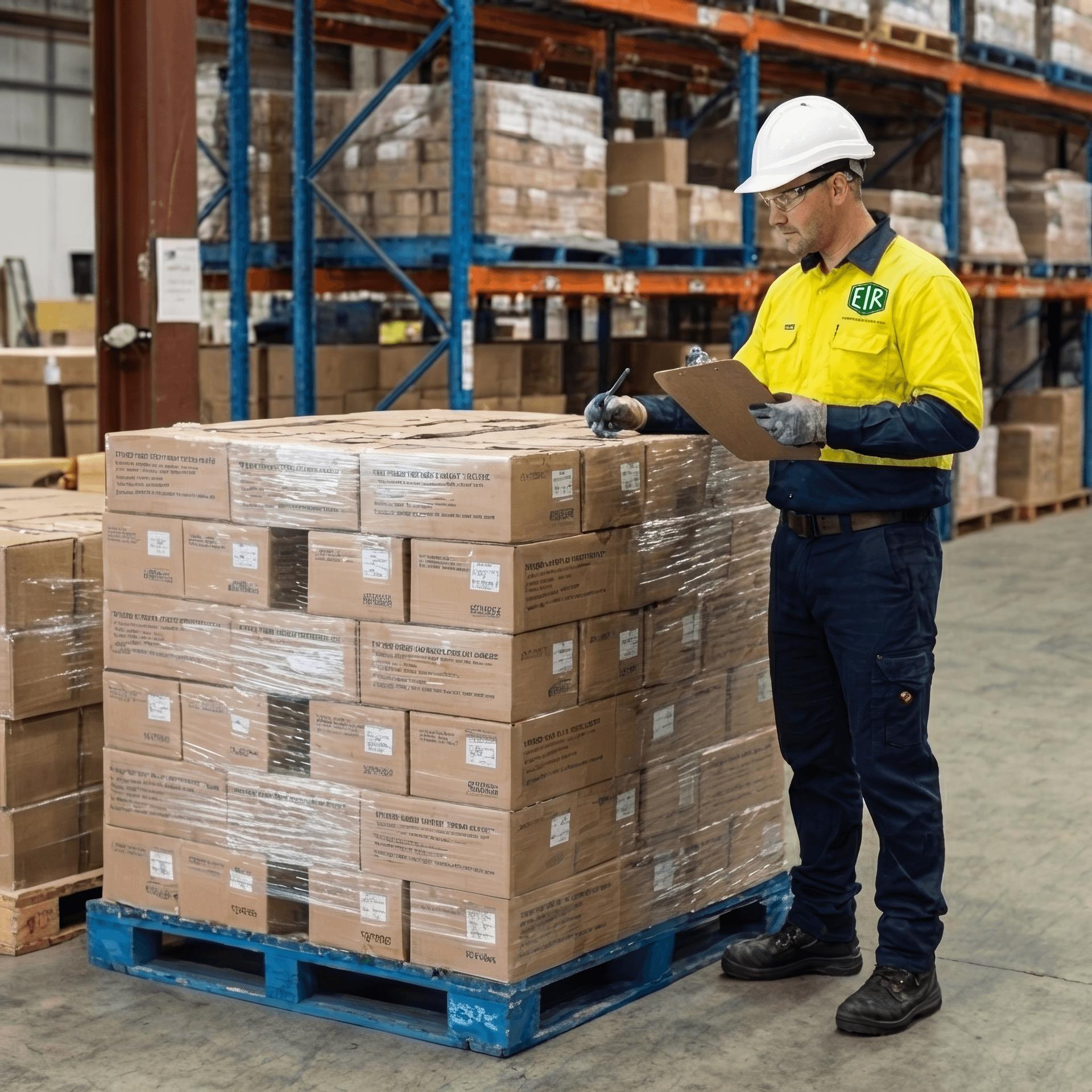
Across the manufacturing businesses EIR works with — in food processing, logistics, fabrication, and civil supply chains — the roles that are genuinely difficult to fill right now include:
- Licensed forklift operators with experience in automated or semi-automated warehouses, where the environment is more demanding and the consequences of an error are higher than in a conventional facility.
- Production operators who can work across multiple lines or cells, adapt to changeovers, and identify process deviations without needing close supervision.
- Quality inspectors and process checkers who understand what they are looking for, can document findings correctly, and flag issues without being told to.
- Admin and coordination support — scheduling, despatch, inventory coordination — roles that sit at the interface between production and the systems that manage it, and require people who are accurate, reliable, and can communicate what is happening on the floor.
These are not entry-level roles. They are not roles you fill with whoever is available today. They are roles where a bad hire or a poorly matched worker creates problems that show up in your output quality, your safety record, and your production schedule.
The labour hire answer is not less — it is better matching
The assumption that automation reduces the need for labour hire misreads what labour hire is actually doing in a manufacturing operation. The value of a well-run labour hire relationship in a manufacturing context is not filling bodies. It is matching workers to roles with the right skills, the right licences, and the right experience to work in your specific environment reliably from day one.
When a manufacturer moves to a higher-automation environment, the stakes for getting that match wrong go up. A worker without the right forklift endorsement working next to an automated system is a WHS exposure. A production operator who has never worked in a facility with automated changeovers creates downtime that is disproportionate to the wage saving from rushing the placement. A quality inspector who cannot document a non-conformance correctly creates audit exposure.
The answer is not to stop using labour hire. It is to use a provider that can actually deliver workers who are matched to what your operation requires — not just workers who are available and willing to turn up.
What EIR does differently when it comes to manufacturing placements
EIR Labour Hire has been placing workers across civil, construction, manufacturing, and warehousing since 2003. In manufacturing and logistics, that means we know the difference between a forklift licence and a forklift operator, between a production worker who has done packing and a production operator who can work a semi-automated line, and between an admin person who can enter orders and one who can actually coordinate despatch.
Every worker EIR places — labourers, forklift operators, production operators, quality inspectors, and admin support — is screened face to face. We verify licences and tickets, check experience, and match people to environments that fit what they can actually do. We do not send someone to a role and hope for the best. That approach was always the wrong one. In a higher-automation environment, it is genuinely not viable.
For operations across South Australia, New South Wales, and Queensland, we provide labour hire services to manufacturing and warehousing clients who need workers matched to their environment — not just workers placed to fill a gap in the roster.
The question worth asking your labour hire provider
If your facility has changed in the last three years — new equipment, new processes, higher safety requirements, tighter quality standards — the question to ask your labour hire provider is not “can you send us someone for tomorrow?” It is “do you understand what tomorrow looks like on our floor, and can you match us to someone who can actually work in it?”
If the answer is a confident yes, test it. Ask what they know about your industry, your equipment, and your environment. If the answer is vague, that tells you something important before the wrong person arrives on your site.
Automation is raising the bar for what reliable labour hire looks like in Australian manufacturing. The providers that can clear it will be valuable long-term partners. The ones that cannot will cost you more than their placement fee.
Sources: Ai Group State of Industry Report 2025–2026; McKinsey Global Institute manufacturing automation analysis; ABS Manufacturing Activity (cat. 8301.0); Deloitte Insights, “The Future of Work in Manufacturing” (Australian edition); Infrastructure Australia, Workforce Pipeline Report 2025.