
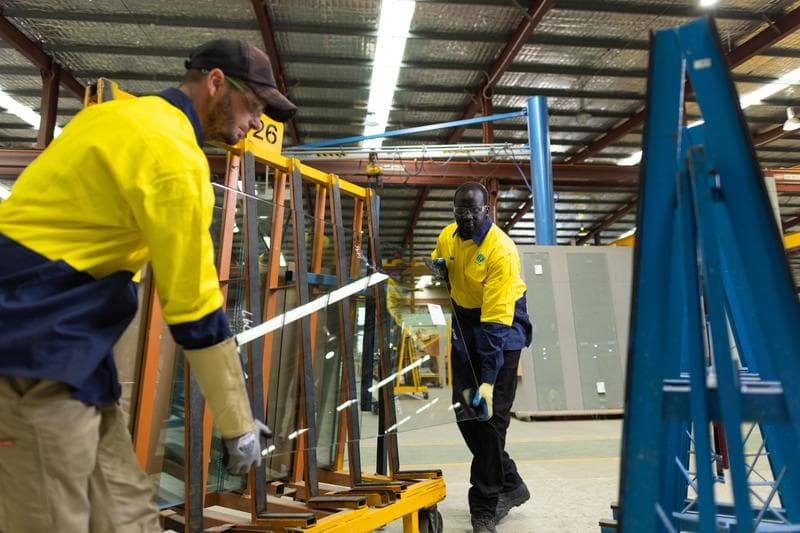
It is 5:45 on a Tuesday morning. Two of your labour hire crew have not badged in. You ring the provider. It goes to voicemail. You text. Nothing. At 7:10 someone calls back to say they are "looking into it". By then the line has been running short for over an hour, your leading hand is doing a packer's job instead of his own, and the day's target is already behind.
Most production managers have a version of that morning. And most of them file it under "people problems" — an unreliable worker, a slack agency, bad luck. It is not a people problem. It is an operational gap in your supply chain, and it should be managed like one.
Labour is an input. Treat it like one.
No manufacturer would accept a raw material supplier who did not answer the phone when a delivery failed. You would have a contact, a lead time, a backup, and a conversation about what happens next. Labour hire is the same category of input — it is just delivered in hi-vis rather than on a pallet — and it deserves the same standard.
The Ai Group's Australian Industry Outlook for 2026 makes the stakes plain. Sixty-nine per cent of industry leaders expect workforce shortages to affect their business this year, and among manufacturers 44% expect shortages in lower-skilled roles and 54% in higher-skilled ones. Only 9% of leaders plan to grow headcount as a growth strategy; the rest intend to get more out of the workforce they have. When your own headcount is that tight, every contracted worker on the floor is load-bearing. A quiet provider is a supplier risk you have not priced.
What an unfilled shift actually costs a factory
In construction, a no-show costs a day. In manufacturing it costs output, and output is measured by the hour.
ABB's Value of Reliability survey found 69% of Australian industrial businesses experience unplanned outages at least once a month, and put the median cost of unplanned downtime for the Australian businesses surveyed at around $349,000 an hour. That figure comes from large plants in energy, chemicals, food and beverage and metals, and your number will be smaller. But the logic is identical whether your line is worth $3,000 an hour or $300,000: a machine that stops because nobody is there to run it is downtime, and downtime does not care why.
Then there is the quieter cost. When a provider is vague about whether a replacement is coming, your supervisor cannot re-plan the shift. They wait. They pull someone off a task to cover, and that task slips. If the replacement turns up at 9:30 with no induction and no idea what the job is, the supervisor spends the next hour training instead of running the floor. None of that appears on an invoice. All of it comes out of your production.
The three ways a provider goes quiet
Hard to reach. The number you have is a recruiter who works 8:30 to 5. Your shift starts at 6. The gap between those two facts is where your worst mornings live.
Slow to replace. They answer, but a replacement is "tomorrow, probably". That means the provider does not hold a pool of screened, inducted workers ready for your type of work — they are going to start ringing around after they hang up from you.
Vague about what is happening. This is the one that does the most damage, because it stops you from making a decision. "We are looking into it" is not information. "Two of yours called in sick at 5:20, we have one confirmed for 7:00 and are chasing a second, I will ring you by 6:30 either way" is information. You can run a shift on the second one. You cannot run one on the first.
Why this hits manufacturing harder than construction
A construction site has some slack in the programme. Trades can be resequenced, a pour can slip to the afternoon. A production line running a continuous process or a just-in-time order cannot. Food and beverage, packaging, metal fabrication, timber, plastics — the shift starts when it starts, and a gap on the line is a gap in the day's numbers that never comes back.
Manufacturing also draws on roles that are hard to fill at short notice. Jobs and Skills Australia's 2025 Occupation Shortage List has 29% of assessed occupations in national shortage, and forklift drivers remain in shortage across regional Australia, where employers fill only 67% of advertised vacancies against 71.5% in the cities. A provider without a pre-screened bench of forklift operators, production workers and process hands is not going to conjure one at 6am. Which is why the conversation about communication needs to happen before you need it, not during.
The standard you should expect
None of this is exotic. It is the same standard you would hold a freight company or a maintenance contractor to. Put it in writing at the start of the relationship and hold the provider to it.
One contact who knows your site. Not a call centre, not whichever recruiter is rostered on. A named person who has walked your floor, knows which roles are critical, and can make a decision without checking with someone else. At EIR, that is how we set every manufacturing client up — one operations coordinator, and you are not handed to a new one every six months.
Reachable when your shift starts, not when their office opens. If your first shift is 6am, the provider needs to be answering at 5:30. Our coordinators are allocating and confirming workers before dawn because that is when a manufacturer finds out someone is not coming.
Proactive, not reactive. The provider should be ringing you about the no-show, not the other way round. If a worker has called in, you should hear about it from the provider before you notice the empty spot on the line.
A straight answer, fast. Confirmed, not confirmed, or do not know yet — with a time by which you will know. A provider that will tell you "we cannot fill that today" is more useful than one that says "leave it with us" and goes silent, because you can plan around the first and not the second.
A bench, not a phone list. Ask how many screened, inducted workers they have available for your type of work this week. If the answer is a pause, that is your answer. Every worker EIR places has been interviewed face to face and skill-checked against the role before they are ever offered to a client — which is what makes a same-morning replacement possible rather than a promise.
Licensed, and able to prove it. In Queensland, using an unlicensed labour hire provider is an offence for the host as well as the provider. A provider who is slow to produce their licence number is telling you something about how they handle everything else.
Questions to ask your provider this week
Who do I ring at 5:45am, and will they pick up? What happens if two people do not show — in what order, and by when? How many inducted workers do you have on the bench for my roles right now? When did you last ring a client to tell them about a problem before the client rang you? Those four questions, asked before a bad morning, tell you most of what you need to know.
The plain version
A labour hire provider who goes quiet is not an HR nuisance. It is a supplier failing on lead time and communication, and it costs you output by the hour. Hold them to the standard you hold every other supplier to — a named contact, reachable when your shift starts, who tells you straight what is happening and has the bench to fix it. If they cannot meet that, the problem is not your workers. It is your provider.
EIR Labour Hire
EIR Labour Hire has been supplying workers across civil, construction, manufacturing and warehousing since 2003 — over 22 years. We place labourers, operators, tradies and admin support in Queensland, New South Wales and South Australia, and we are licensed in every state that requires it.
For manufacturers, that means one operations coordinator who knows your floor, workers screened face to face and skill-checked before they arrive, and a straight answer when you ring — before your shift starts, not after. If that is not what you are getting now, talk to us about manufacturing labour hire in Brisbane and Southeast Queensland.
Sources: Australian Industry Group, Australian Industry Outlook for 2026 (13th Annual Industry Leaders Survey, January 2026) — workforce shortage expectations by industry and skill level, growth strategies; ABB, Value of Reliability survey (Sapio Research, July 2023; published October 2023) — frequency and median hourly cost of unplanned downtime for Australian industrial businesses; Jobs and Skills Australia, 2025 Occupation Shortage List and Additional Insights Report (October 2025) — share of occupations in shortage, regional vacancy fill rates, forklift driver shortage status; Labour Hire Licensing Act 2017 (Qld). This article is general information, not legal advice.